When it comes to places to visit in Pune, there is a long list that follows and varies as per the choice of the person looking and the one who is recommending. But there is one thing we can agree on, and that is how Pune is the perfect place to spend your time and enjoy it all. The Marathi culture and the modernisation go in hand in hand in this unbelievably beautiful city. Surrounded by many mesmerising attractions, the city of Pune is no less attracted to many coming from outside, sometimes from even as close Mumbai to enjoy their weekends.
Top Tourist Places in Pune:
– Shaniwar Wada Palace
– Parvati Hill
– Pashan Lake
– Aga Khan Palace
– Vetal Tekdi
– Shinde Chhatri
– Pataleshwar Cave Temple
Must Visit Places in Pune
- Shaniwar Wada Palace
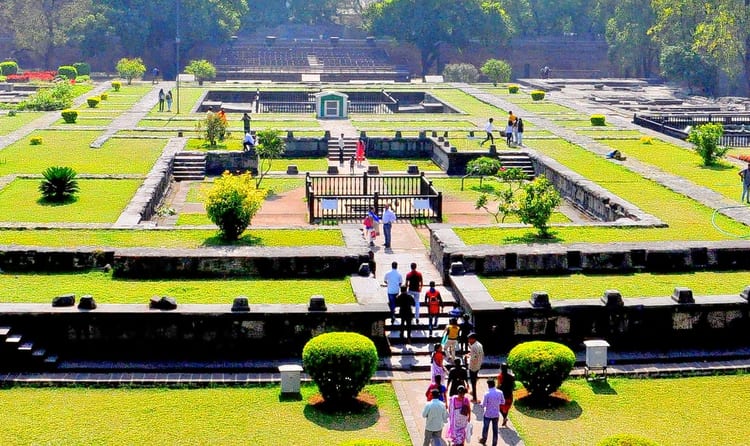
A prominent historical landmark in Pune is Shaniwarwada. It is a majestic fortification as well built in 1732 and during that time it was the seat of the Peshwas of the Maratha Empire and they ruled over there until 1818. After they lost control to the British East India Company, they could not use it longer. But when they were in the reign, Shaniwarwada was the centre of Indian politics in the 18th century.
The doorways were made of teak arches with ornamental teardrop teak pillars shaped like Suru trunks. Ceilings were beautified by numerous chandeliers and the floors were filled with polished marble adorned with rich Persian rugs. The walls displayed paintings depicting the Hindu epics. The top floor of the building enacted as the residence of the Peshwa and it was called Meghadambari.
Entry timings: It is open on all days of the week from 08:00 am to 06:30 pm and there is a Light and Sound Show every day and the tickets for the show can be booked every day from 06:30 pm to 08:30 pm.
Entry fee: For Indian citizens, the entry fee is INR 5 and for foreign nationals, it is INR 125. For the Light and Sound Show, the ticket fee is INR 25 per person.
Location: Shaniwar Peth, Pune, Maharashtra 411030.
2. Parvati Hills

A major picnic spot near Pune is Parvati Hill, a huge hillock that rises to 2100 feet above sea level. It holds Pune’s MSL that is located at a height of about 560 meters from sea level. Parvati temple located on the top is one of the primary reasons why the hill is quite famous among the tourists and the locals.
The hillock offers the best view of the serenity lying down in the town and this is the most scenic location in Pune. Parvati temple possesses a special feature of being the oldest heritage structure in the city and it was built during the period of the Peshwa dynasty. It is an observation point that incredibly unveils the panoramic view of the lush greenery and flamboyant sky above the location.
Entry timings: The hill is open on all days from 08:00 am to 05:00 pm but the temples will be open from 05:00 am to 08:00 pm.
Entry fee: There is no entry fee is needed to climb up the hill.
Location: Parvati Hill, Parvati Paytha, Pune, Maharashtra 411009.
3, Pashan Lake

A captivating yet artificial lake near the suburbs of Pashan Hills is Pashan Lake located at a distance of 12 kilometres from the city centre of Pune. It was built during the British era in order to fulfil the water requirement of the natives in the region and neighbourhood. Ram Nadi, a small rivulet is the inlet of the huge lake and it is controlled by the barrage at the north side of the lake.
It is also a catchment area that spreads across an area of 40 square kilometres and it gives water to the old Pashan Village, the Governer’s Residence etc. But unfortunately the urbanisation caused the lake to welcome deterioration and the quality of the water dropped down to a large extent.
Currently, it is unlikely a polluted river restraining people from drinking it. But still the picturesque value the location possesses attracts thousands of tourists to spend ample time gazing at the brilliant spot and there are a lot of migratory birds visit the lake during winter. There is a Nature Trail on one side of the lake constructed by Pune Municipal Corporation which is 300 meter long and thus people can walk through and watch the man-made lake.
PMC has also built a bamboo plantation as well as a wall to protect the lake from outside attacks. Due to the recent deforestation on the nearby hills forced the lakeside to accommodate many silt formations and thus the depth of the lake was decreased. After the deterioration of the water, Pune Municipal Corporation stopped providing drinking water from the lake in 1998. But now, it is being studied and analysed for providing portable water once again.
Entry timings: You can visit the lake any time round the year.
Entry fee: There is no entry fee is applicable to spend time at the lake.
Location: Pashan | 12 Km from Pune, Pune 411021, India.
4. Aga Khan Palace

Yet another famous landmark in Pune is the Aga Khan Palace which was built by Sultan Muhammed Shah Aga Khan III in 1892. In the history of India, this palace placed itself on a prominent space as one of the biggest landmarks in India. As an act of charity, the palace existed and the Sultan who built it wanted to help the poor in the region.
The mighty monument is considered to be a sparkling jewel in Indian history which had a close connection with the Indian freedom movement since it served as a prison for Mahatma Gandhi and his wife, his secretary, and Sarojini Naidu. Kasturba Gandhi and Mahadev Desai, the secretary died in this palace.
Archaeological Survey of India declared the palace as a monument of national importance in the year 2003. Aga Khan, the brilliant mind behind the birth of this majestic monument donated the palace to the Indian people as a mark of respect to Gandhi and his philosophy in 1969 and currently, the palace holds itself the vast collection of memories and it is a memorial on Gandhi where his ashes were kept. In the later years, the prominence of the palace started diminishing and the authorities neglected the importance of the monument and thus it was becoming unattended as well.
The palace is exactly situated about 2 kilometers away from Bund Garden in Yerwada on Pune Nagar Road. The palace presents Utalian arches and a huge lawn at the front and it houses five falls. The total area in which the palace is situated in 19 acres including the lawn and other spaces.
It is an important archive as well that showcases the number of photos and portraits of the life of Mahatma Gandhi and other important figures of the Indian freedom struggle. It acts as the headquarters of the Gandhi National Memorial Society.
Entry timings: You can visit the palace on all days from 09:00 am to 05:30 pm.
Entry fee: For Indian nationals, the entry fee is INR 5, whereas for foreign nationals it is INR 100.
Location: Pune Nagar Road, Kalyani Nagar, Pune, Maharashtra 411014.
5. Vetal Tekdi

A prominent hill in the city limits of Pune is Vetal Hill which is the highest point at an elevation of 2600 feet. Vetala temple is also located on the top of the hill and that is how the hill got its name as Vetal Hill. Adventure seekers come here in plenty to escape from the hustles and bustles of the city and it is a great morning trek location.
Near the temple, there is an observation desk set up by the Indian Forest Department. Vetal Tekdi is the Marathi name and from the hilltop, one can watch the Pune city as a whole on a clear day. The hill is a part of Bhamburda Van Vihar on the western side of Pune Municipal Corporation.
Vetal Tekdi has two spurs named Fergusson College Hill and Chatturshrungi Hill. There is one access road that takes people up the hill from the south. Also, a public parking lot is located along the road but the access to it is restricted to between 08:30 am and 05:30 pm. The area has been undergoing some anthropogenic activities for last some years- plantation of many exotic species, urban development, deforestation etc are a few of the activities that make the hill important.
Currently, Vetal Hill is an area protected by the India Forestry Department and the State Forest Department and Pune Municipal Corporation have done a lot of afforestation programmes on a large scale and thus now the hill accommodates different species of flora and fauna. If you plan to trek to the hill, then try to carry drinking water and snacks. There are three ways or direction to reach the hill; from Kothrud, Pashan, Chaturshringi.
Entry timings: There is no particular timing to visit the hill but it is advised to trek up the hill before dawn to enjoy the beautiful sunrise and the unbeatable serenity.
Entry fee: No entry fee is applicable to trek the hill up.
Location: Pashan, Pune 411038, Maharashtra.
6. Shinde Chhatri

- Shinde Chhatri is a memorial dedicated to the 18th-century military leader Mahadji Shinde and it is the main attraction and a well-known place in Pune. Mahadji Shinde served as the commander in chief of the Maratha army under the rule of Peshwas from 1760 to 1780.
The majestic representative of the Maratha rule houses a hall that marks the spot of Mahadji Shinde’s cremation on 12th February 1794. During 1794, the memorial had only one temple dedicated to Lord Shiva built by Mahadji Shinde himself and in 1965 only, a Samadhi was constructed outside the sanctum of the Shiva temple.Madhavrao Scindia was responsible for the construction of the complex along with the memorial.
The architecture of the building is the main attraction as it resembles the architectural styles used in Rajasthan along with a touch of the Anglo style. It shows a picturesque blending of two different cultures.The beauty of the building is heightened due to the presence of fine, alluring carvings. The carvings and the idols of the saints of the Shiva temple are made of yellow stone and the floor of the sanctum sanctorum is constructed using black stone.
The hall inside the structure is decorated beautifully with paintings and photographs of members of Shinde family. But it began to accommodate bad conditions as years passed but currently, its glory being recovered by painting the walls and restoring the old beauty to it. The historical identity and the architectural brilliance played on the walls of the building make it a famous tourist destination in Pune.
Entry timings: The building remains open on all days of the week from 06:00 am to 09:00 pm.
Entry fee: There is no entry fee to visit the landmark.
Location: Wanowrie, Pune 411001, India.
7. Pataleshwar Cave Temple

An atypical rock cut cave temple in Pune is the Pataleshwar Cave Temple which is an ancient temple that dates back to the 8th century during the Rashtrakuta period. The temple is also known as Panchaleshvara or Bamburde temple. Originally, the temple’s location was outside the town and when the city limits were expanded, the temple is situated now on the downtown Jangli Maharaj Road. It has been declared as a protected monument by the government.
The temple is dedicated to the Hindu god Shiva and it is made of basalt rock which has a cube-shaped sanctum 3-4 meters on each side. It holds a linga which represents the god and there are two smaller cells on each side.
A circular Nandimandapa is placed in front of the cave but its umbrella shaped canopy held by massive square pillars is the main component that makes the temple’s beauty heightened. The Nandimandapa is yet another feature of the temple. The cave is situated at a lower level than the present level of the road.
The main structure of the cave is rectangular in shape with a pillared porch. Along with the main sanctum, there are other three sanctums as well. To circumambulate, there is a path provided inside the temple and the unfinished part of the cave temple can be seen while you rotate it.
However, the inside walls of the temple possess grandly some inscriptions and drawings depicting the stories from Indian mythology, especially revolving around Lord Shiva. The cave complex is turned out to be a garden and also, you can see some architectural members which were parts of other old temples nearby. The incomplete Temple is the main tourist attraction as well but the locals come here to celebrate the Shiva Linga Pooja that would be done with ghee and yoghurt.
Entry timings: 08:00 am to 05:30 pm.
Entry fee: There is no fee is applicable to enter the temple.
Location: Jangli Maharaj Road, Revenue Colony, Shivajinagar, Pune, Maharashtra 411005.
8. Mulshi Lake and Dam

n the recent years, Mulshi Lake and Dam have been reformed to be one of the major tourist destinations in Pune and those who love to capture the pleasant pictures of nature at its best flood toward this lake and dam built on the famous Mula River. It is located in the Mulshi Taluka administrative division of the Pune district.
The water from the dam is taken to use for irrigation and producing electricity at the Bhira hydroelectric power plant. The power plant is operated by Tata Power. The station is operating six 25 MW Perton turbines and one 150 MW Pumped Storage Unit. An inimitable weekend gateway from Pune to the precious nature filled by the Sahyadri ranges, Koraigadh and Dhangad Fort and other major attractions is the dam and lake.
The lake and dam can be witnessed from a nearby village that is Valanewadi, located about 6 kilometres away from Mulshi. It is also a perfect spot for birding, nature walk, photography and because of the pristine nature’s influence on the location so well. During monsoon, the lake and dam will be overflowing and the gushing water produces some soothing voices enough to let any perplexed mind to be relaxed. Hence people come to enjoy the beauty of the lake and dam during the heavy rainy season.
Entry timings: It is open from 09:00 am to 06:00 pm.
Entry fee: No entry fee is applicable to visit the dam and lake.
Location: Mulshi Taluk, Pune, Maharashtra 412108, India.
9. Raja Dinkar Kelkar Museum

An intriguing museum with a lot of references to the medieval history of India is located in Pune and that is the most famous attraction of the city, Raja Dinkar Kelkar Museum. It possesses the rare collection of Dr. Dinkar G Kelkar dedicated to the memory of his sone, Raja. There are three floors for this museum displaying different types of sculptures dating back to the 14th century along with ivory, silver and gold items and musical instruments, war weapons, vessels etc. The collection began in 1920 and by 1960, the museum was filled with 15000 objects and later in 1962, Dr. Kelkar donated all the collections to the Government of Maharashtra. Currently, if you visit the museum, you will come across more than 20000 objects out of which 2500 only are on display.
The museum showcases the different artistic materials found from different parts of India from the 18th and 19th centuries. The collection includes door frames, vessels, paintings, handicrafts, carvings etc. Museum 2000 is a project that has been started to make Dr. Kelkar’s dream of an education and cultural museum come true and to be opened to the public in order to provide them proper knowledge on the artistic values of India. Museum Shop is an additional venture at the museum that will give attractive souvenir items at a reasonable rate and it is located at the exit point.
Entry timings: You can visit the museum round the year and it will be open from 10:00 am to 05:30 pm.
Entry fee:
-Rs. 10.00 for children below 12 years
-Rs. 50.00 for adult above 12 years
-Rs. 200.00 for foreigners (adult)
-Rs. 50.00 for foreigners (children)
-Entry is free for blind and differently abled/ physically challenged visitors.
10. Dagdusheth Halwai Temple

A famous Ganesha temple in Pune is Shreemath Dagdusheth Halwai Temple which is a major attraction in Maharashtra. The temple is visited by thousands of pilgrims every year. The annual ten-day celebrations named Ganeshotsav is the main festival conducted at the temple when celebrities and ministers arrive to pay tribute to the Lord. The main idol is insured for a sum of Rs.10 million. Dagadusheth Halwai was the founder of the temple who was a trader, businessman and a sweet maker. He was from Karnataka and settled in Pune long ago. But his son died due to an epidemic and afterwards he and his wife fell into steep depression and to heal themselves, they were advised to build a Ganesh temple by their Guru Shri Madhavnath Maharaj.
The construction of the temple was finished in1893. The great leader Lokmanya Tilak was a contemporary of Dagdusheth and a close friend of him. He had the idea of celebrating Ganesh festival at the temple and then onwards, it became an epoch-making event. The beautiful temple has Jay and Vijay, the two sentinels made of marble attracts the millions of hearts coming to visit the temple. The temple was constructed very simply so that the idol of Ganesha can be seen from outside. The idol is huge with 7.5 feet height and 4 feet width. It was made more beautiful by adding nearly 8 kilogrammes of gold. Devotees of the temple offered money and gold regularly and heaps of coconuts are also a special offer done by the people.
Entry timings: The temple is open on all days from 06:00 am to 11:00 pm.
Entry fee: There is no entry fee to be paid to enter the temple. Special poojas and offerings may cost differently.
Location: Ganpati Bhavan, 250, Budhvar Peth, Shivaji Road, Pune, Maharashtra 411002.
 Anshul's Blog